The Methane Wars: Part III
The victims of what is now being sold as “regenerative agriculture”
The Paraguayan government, corporations and trade associations are seeking to position pesticide-treated soybean plantations under the banner of regenerative agriculture in South America. But in two villages in eastern Paraguay, residents are suffering the consequences of poisoning and crop loss.
- Reporting and writing: Maximiliano Manzoni - 2025 Bertha Challenge Fellow
- Editors: Paula Diaz Levi & Francisco Parra
- Photos: Nicolás Granada
The stifling heat of January 6, 2011, was compounded by fever and vomiting. Rubén Portillo was unable to get up to harvest the watermelons he had planted to cool off in the summer.
They were different symptoms, thought his partner Isabel Bordón, compared to the spots that had appeared in his mouth during the December holidays. From the last house in Colonia Yerutí, a few meters from the stream that gives its name to the rural community in eastern Paraguay, Isabel called her sister-in-law and neighbor Norma Portillo.
Norma rented a truck to take him to the hospital in Curuguaty, the most populated city in the department, an hour away from the colony. As they drove along the dirt and mud road, the characteristic green color of soybean crops stretched out along the slopes.
Rubén couldn’t bear the hour-long journey. Until that morning, the 26-year-old, the only boy among four sisters and father of a two-year-old boy, had what fewer and fewer farmers in his country have: land to plant something on.
He arrived at the hospital dead.
Over the next few days, alive but with similar symptoms, his son Diego, his partner Isabel, and his brother-in-law Ceferino arrived at Curuguaty Hospital. In total, 17 people from Yerutí ended up in hospital.
After taking blood and urine samples, the hospital director made three calls. One to the Public Prosecutor’s Office, another to the Secretariat of the Environment (now the Ministry), and one to the National Plant and Seed Quality Service (SENAVE).
The latter is the entity in charge of controlling pesticide use in Paraguay.
In October 2023, when the European Union was considering whether or not to extend the license for the use of glyphosate in agricultural crops, South American agribusiness, as on so many other occasions, presented a united front.
In addition to the common arguments regarding food security, in a joint statement, the Argentine Soybean Chain Association (Argentina); the Argentine Association of Direct Seeding Producers (AAPRESID, Argentina); the Brazilian Association of Soybean Producers (APROSOJA, Brazil); the Association of Soybean, Oilseed, and Grain Producers of Paraguay (APS, Paraguay); the Paraguayan Chamber of Grain and Oilseed Exporters (CAPECO, Paraguay); and the Oilseed Technology Board (MTO, Uruguay) put forward a new argument: without glyphosate, regenerative agriculture would not be possible.
“Glyphosate is a crucial tool in regenerative agriculture systems, where non-tillage and soil cover are a fundamental basis of a holistic approach that integrates technologies that help farmers produce more with less, promoting biodiversity, building resilience, and reducing carbon footprint.”
Thus, after having been one of the main contributors to the deforestation of the Atlantic Forest for decades, the soybean industry embraced a new commodity consensus.
One that had already been announced by Bayer, the company that owns the patents for the herbicide after buying Monsanto: glyphosate is “an important element for sustainability and regenerative agriculture,” said Rodrigo Santos, director of Crop Science Bayer, in an interview in September 2023, a month before the South American agribusiness announcement. It was an interview for European media, with the same goal of lobbying for approval in the EU.
This is a pivot to the dilemma that Monsanto, before being bought by Bayer, faced in this regard. In a 2008 internal email from the corporation leaked in the Monsanto Papers, one of its executives asked “how they could combat” a study linking the use of glyphosate to the onset of Hodgkin’s lymphoma. The executive was not only concerned about health issues, but also that environmental organizations were using the study to call for “avoiding carcinogenic herbicides by supporting organic agriculture and non-toxic land care strategies that prioritize soil health, not toxic herbicides.”
By that year, glyphosate and other agrochemicals were already legally available in countries such as Paraguay. Before its approval in the 1990s, soybeans in Paraguay were nicknamed “Maradona” because of their ability to dodge controls and be smuggled in from Argentina and Brazil.
This is how the United Republic of Soy (República Unida de la Soja) was built, as Syngenta called it in a 2003 advertisement, referring to the area between Argentina, Brazil, Paraguay, Uruguay, and Bolivia where the soybeans displaced forests, grasslands, and populations such as that of Yerutí, using genetically modified seeds to withstand the use of pesticides and herbicides such as RoundUp.

By 2011, the year Rubén Portillo died, Paraguay was using 22,283 tons of agrochemicals. The number had grown sevenfold since genetically modified soybeans became legal in 2000.
But the soybeans should not have been just a few meters away from the Portillos’ house.
No justice for Rubén, no rest for Norma, no school for Diego
Norma Portillo recalls that, exactly one week after her brother Rubén’s death, environmental technicians from the Paraguayan government arrived in Yerutí. The colony had been founded in 1991 on 2,212 hectares divided into 223 plots, land that a former education minister under dictator Alfredo Stroessner had given away to compensate for the theft of public funds.
The name Colonia (Colony) meant that, in theory, it was the government’s responsibility to plan with small peasant farmers what would be planted and how. It also meant ensuring that their products could be sold. But when the technicians arrived in Yerutí, they found almost no food crops.
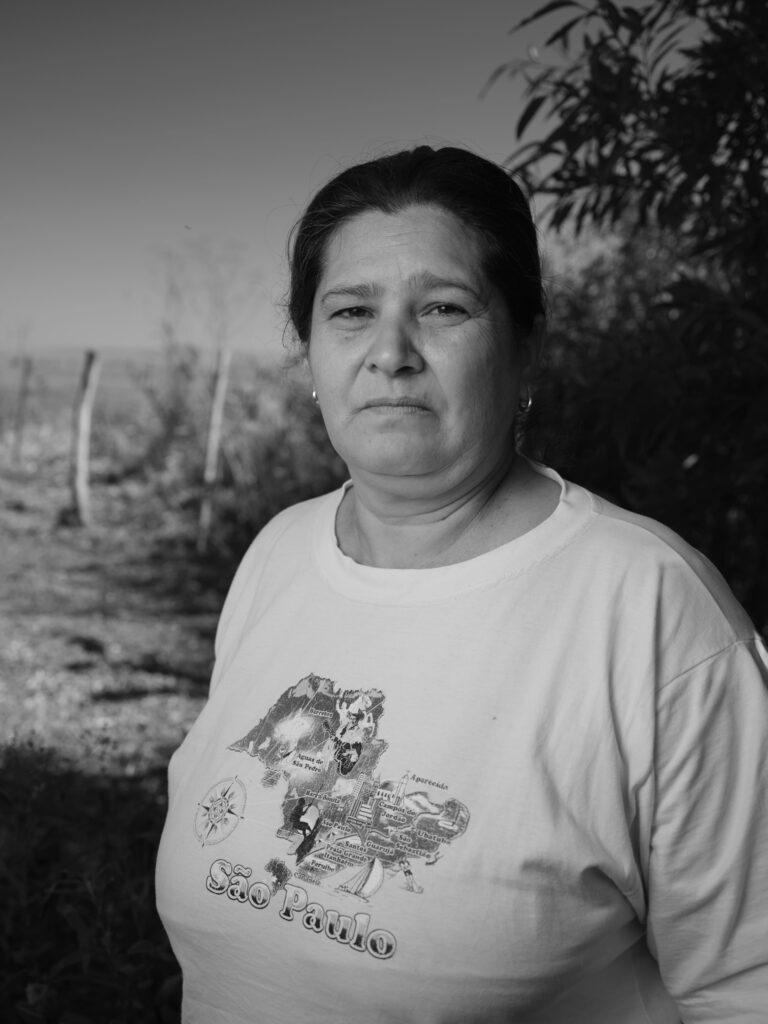
They found soybeans, lots of soybeans, planted on land without title deeds, that is, public land.
Of the 223 plots in Yerutí, the state only granted title deeds to 34. The Portillos are not among the owners, even though they finished paying for their land more than 10 years ago.
SEAM and SENAVE technicians also found what can still be seen 14 years later when traveling along the same rough dirt road that connects the neighborhood to the pristine routes used to transport grain to the ADM and Cargill silos: that the soybean plantations do not comply with the required tree barriers between the crops and the road, or the minimum 100-meter distance established for the use of agrochemicals near homes, schools, and health centers.
None of which became law in Paraguay after the death of Silvino Talavera, an 11-year-old boy who died of glyphosate poisoning in 2003. Like Portillo, Talavera also died in January. It is the month when soybeans are sprayed for harvest.
Norma recalls that “months before Rubén’s death, ”they began to see crop dusting planes flying over their fields. In the mornings, the characteristic white color of glyphosate settled on the fruit trees and subsistence crops of the farmers.
After Rubén’s death, endosulfan, aldrin, and lindane—three agrochemicals banned in Paraguay—were found in his water well. “I don’t know if they were playing around, trying out new poisons without knowing what they were,” Norma speculates. Lindane, for example, is not used on soybeans. But endosulfan is. Until 2010, it was freely available for sale in Paraguay, and 80% of it was used on that crop.
In an interview with Radio Fe y Alegría, which would later prove crucial, Ulises Lovera, then director of environmental control at the Ministry of the Environment—and who 10 years later would become director of Climate Change—angrily described what they saw in Yerutí. «We found two large properties, one belonging to the Hermanos Galhera company and the other to the Condor company. Neither of them met the most basic environmental requirements.“ It later emerged that ”they didn’t have any licenses,» says Norma, recalling the case file, neither to plant soybeans nor to spray agrochemicals with small planes, whose tanks were then washed in the stream a few meters from Rubén’s house. The residents of Yerutí used to fish in that stream.
Although the Public Prosecutor’s Office opened an investigation into environmental crimes, the investigation never progressed.
Prosecutor Miguel Ángel Rojas requested three times that an autopsy be performed on Rubén to see if there were traces of agrochemicals. It was never done. The diagnosis, medical records, and urine and blood tests of the Yerutí patients who had prompted the director of the medical center to call the authorities in the first place also disappeared from the Curuguaty Hospital.
Miguel Ángel could only confirm that Rubén arrived at the Curuguaty Hospital dead.
The prosecutor also failed to include the official results that other government agencies had obtained from analyzing the water wells where agrochemicals were found. Nor did he investigate whether the aerial spraying of what Norma believes was glyphosate was registered with the Aeronautics Directorate.
Nor did he charge the owners of Hermanos Galhera and Condor. Instead, Norma recalls, “he charged seven Brazilians who had nothing to do with it” based on a list of possible environmental crimes provided by the police. Norma filed a constitutional appeal under the article establishing the right to a healthy environment: only the Ministry of the Environment admitted that she was right. All of this was ultimately confirmed by the United Nations.
In 2013, with the investigation now in the hands of a new prosecutor, Jalil Rachid, the Paraguayan courts dismissed the charges against the defendants. Jalil is known for failing to investigate the deaths of farmers in the so-called Curuguaty Massacre, which in 2011 brought an end to the progressive government of Fernando Lugo. Today, he is the Anti-Drug Secretary in the conservative government of Santiago Peña.
Norma, who witnessed her brother’s death, brought the case to the United Nations Human Rights Committee in 2016, together with Isabel Bordón, Rubén’s partner, and their son, Diego Portillo. They were supported by the Paraguayan Human Rights Coordinator (Codehupy) on the grounds of violation of the right to life under the International Covenant on Civil and Political Rights.
The Paraguayan state opposed the case, arguing, among other things, that it had been “an isolated case” and that the inhabitants of Yerutí “had not proven that they had been poisoned by pesticides”—even though it was the state itself that had failed to pursue the investigation – and claimed that blood and urine tests “showed values within normal parameters,” although it never provided a document to support these allegations.
On July 25, 2019, more than eight years after Rubén’s death, the United Nations Human Rights Committee ruled that Paraguay had violated the right to life by failing to act on the findings of its own agencies. This failure “allowed massive fumigation with agrochemicals to continue.” It also considered that “massive fumigation with agrochemicals in the area constituted a threat to life” for the Portillo family and the entire Colonia, and that this “was reasonably foreseeable by the State.” It also recalled that a court had already ruled in Norma’s favor in her 2011 appeal for protection, based on reports from the then Ministry of the Environment.
Paraguay became the first country to receive a ruling against it from the United Nations in a case related to agrochemicals.
The ruling required the country to effectively and thoroughly investigate the facts, punish all those responsible, provide full reparation for the damage suffered, including adequate compensation, and adopt measures to prevent similar violations from occurring in the future.
When I first visited Norma, just a few months after the ruling, she was happy about the recognition. But six years later, the Paraguayan government has not only failed to fulfill any of its obligations, soybeans are now planted directly in front of her house. Glyphosate continues to settle on her trees after fumigation. Norma says that because “the bugs run from the poison” in the soybeans, they end up increasingly affecting the production of corn and cassava, the two pillars of the country’s cuisine and subsistence agriculture. As a result, she has resigned herself to planting less and keeping only chickens and a couple of cows on her land.
One of the greatest injustices is that the Paraguayan state not only failed to bring justice for Rubén’s death, but also that, due to the fumigations, fewer and fewer families are living in Yerutí. They rent their land to soybean farmers and move away, in a vicious cycle of commodity expansion and the abandonment of small-scale farming. With fewer families, there are fewer children. And that was the state’s argument for, in 2021, closing the school in Colonia that Rubén’s son Diego attended.
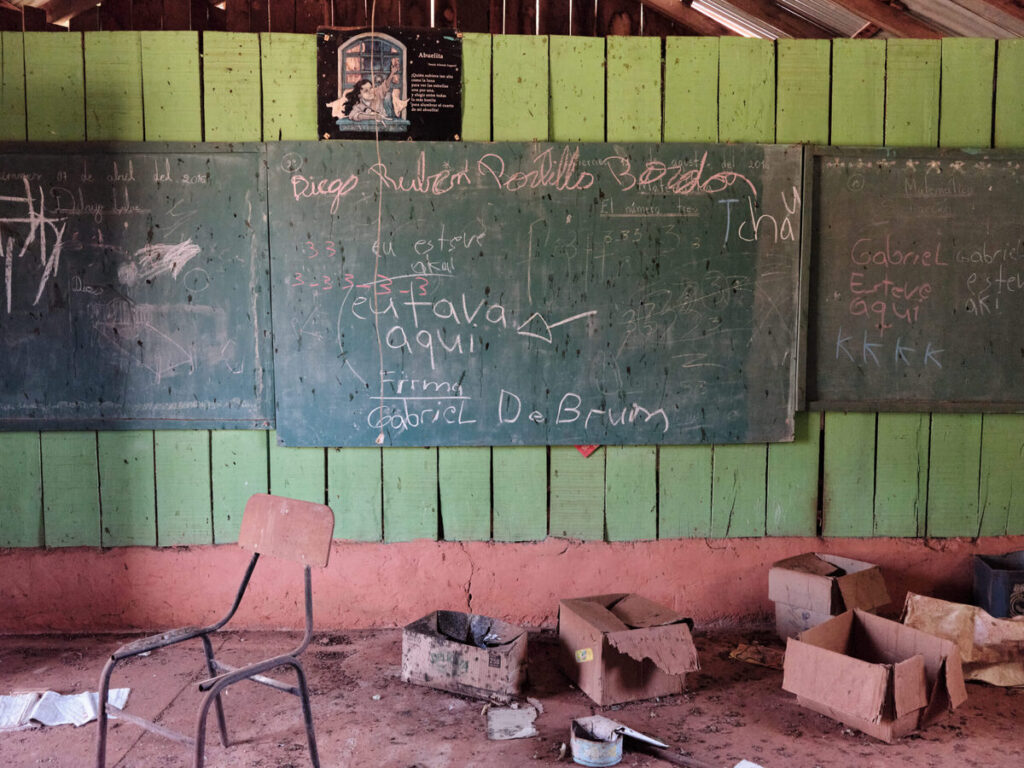
Today, the school seems to have been swallowed up by the expansion of soybean plantations, which can be seen through the broken windows of the two buildings where a teacher used to teach three classes at once. Inside the classrooms, science and ethics notebooks lie abandoned on desks.
In the middle of one of the rooms, a map of Paraguay lies on the floor. When we entered with the photographer, a striking visual broke my reporter’s spirit.
Diego Rubén Portillo Bordón had, at some point, written his name in chalk on the blackboard.
The soybeans that intoxicate towns now are being sold as a climate solution
It is hot in Belém. The 30th Conference of the Parties on Climate Change has just begun. Or, more simply, COP30.
Paraguay, which has arrived with a small delegation, presents its updated climate commitments. It does so eight months late and in a process where the government did not respond to any of the six consultations carried out on methodologies.
Paraguay’s new commitments are very similar to the old ones. They show little ambition in terms of deforestation and are conditional on international support – at the same time as Argentina is moving closer to the denialist government of the United States, the main debtor of climate funds.
The most questionable aspect is that the same Paraguayan state that failed to deliver justice for the environmental violations caused by soy cultivation in Yerutí is now using that same soy to claim that it is fulfilling its climate commitments.
Paraguay’s new Nationally Determined Contribution includes the carbon sequestration from no-till soy cultivation, which, according to the country, sequesters 10 times more carbon than family farming.

The calculation is based on the mapping carried out by the Ministry of Agriculture and Livestock of all crops in the country. The inclusion in the commitments was influenced by the Paraguayan Federation of No-till Farming (FEPADIAS).
It includes the soybean plantations in Yerutí that continue to violate the minimum distances for the use of agrochemicals.

In yellow, soybean plantations officially identified by the Paraguayan government. In red, Norma Portillo’s house, practically the only one in Yerutí without soybean plantations, according to data from the National Forestry Institute (2022).
The Paraguayan Federation of Direct Seeding maintains that “soybeans capture more carbon than forests.”
One of its representatives is Albrecht Glatzle, a climate change denier linked to the European organization CLINTEL. And the president of the Federation is Alfred Fast, former president of the Sustainable Meat Board. Fast denied the existence of climate change at an event in Asunción at the Conservative Political Action Conference (CPAC), where he also stated that environmentalism is “the perfect excuse to attack civilization.”
Paraguayan agribusiness celebrated the inclusion of no-till farming, despite scientific studies pointing to the method’s limited ability to mitigate climate change. Sarah Starman, from Friends of the Earth’s Food and Agriculture division, is more critical: “Food corporations investing in regenerative agriculture must avoid greenwashing concepts such as no-till farming.”
When I asked Norma Portillo what she thought about the idea of soybeans and glyphosate being part of regenerative agriculture, she hurled a recognizable—and irreproducible—insult into the air that would be understandable to any Paraguayan who knows something of Jopara, the mixture of Guaraní and Spanish spoken by most of the country.
“How on earth is this going to be regenerative agriculture? They’re always inventing things,” she continued incredulously.
However, an investigation by Global Witness revealed in 2022 that Hermanos Galhera continued to operate a few kilometers from Yerutí, where it harvests soybeans that it delivers to ADM, and that it owns a silo 10 kilometers from the colony. “According to people working in the sector,” says Global Witness, Galhera also supplies soybeans to Cargill and Bunge.
In an interview in 2024, Antonio Galhera, one of the owners of the company, also mentions that they work “near Curuguaty,” an area that includes Yerutí. Galhera is a managing partner of the Paraguayan Soybean Association, one of the entities that signed the letter to the European Union defending glyphosate as part of “regenerative agriculture.” He was also reported in another case for violating laws on the use of agrochemicals in 2016.
According to Global Witness, neither ADM, Cargill nor Bunge denied having purchased soybeans from the company.
Internationally, the three corporations are promoting the idea of including soybeans and their pesticide package as part of regenerative agriculture.
In South America, ADM launched its pilot project in Brazil, using a methodology developed by Bayer in partnership with the Brazilian Agricultural Research Corporation (Embrapa), which, as we saw in previous chapters of this series, promoted a controversial new way of measuring the impact of livestock farming and was at the forefront of agribusiness events at COP30, including 60 presentations on regenerative agriculture and livestock farming in its pavilions.
Regarding the partnership with ADM and Embrapa, Felipe Albuquerque of Bayer said, “This is a significant step for Bayer. Through collaborative work, science, and technology, we will be able to build a carbon ecosystem with producers and partners. We understand that in agribusiness, we have a goal to mitigate the impact of climate change through the pillars of regeneration, decarbonization, and greenhouse gas removal.”
Cargill, for its part, is promoting pilot projects in other parts of Paraguay to sell carbon credits from regenerative agriculture with soybeans through the Land Innovation Fund, according to a mapping carried out for this research. Bunge announced the same globally in an alliance that includes, among others, the oil company Chevron, in addition to another project in Brazil.
Within Yerutí, less than a thousand meters from Norma Portillo’s house, according to registry data obtained for this investigation, there is still an agrochemical warehouse belonging to the company Issos SA. According to the Yvy Jara report by the organization Base Is, Issos received financing from ADM. The soybean field in front of Portillo’s house belongs to another soybean company, Tieagro SA.
Yerutí’s case is not the only one. Two hours away, dodging trucks entering the Cargill silo from the highway, the soybean fields that got into the bloodstream of the children of Colonia San Juan are now also one of the mitigation measures that the Paraguayan government is presenting in its new Nationally Determined Contribution (NDC) for the benefit of agribusiness.
I don't want to see cometets
“There is scientific evidence of the damage that pesticides can cause,” says Dr. Stela Benitez Leite.
The pediatrician and researcher has been studying the effects of agrochemicals on children and adolescents in Paraguay for almost two decades.
In 2016, she traveled to Colonia San Juan, a village organized under the National Peasant Federation which, like Yerutí, is surrounded by soybean fields despite being located on land recognized by the Paraguayan state for agrarian reform. Together with a team from the Catholic University of Asunción, the doctor collected blood, saliva, and hair samples from 43 children between the ages of 5 and 10 in the community. At the same time, she did the same with 41 other children living in a rural area 150 kilometers away, far from soybean fields.
The scientific team was able to observe the DNA of these children in their blood and hair. DNA is the molecule that contains the genetic material of almost all living beings. It is an instruction manual that encodes our development, functioning, and reproduction.
Under the microscope and when electricity is applied, healthy DNA looks like a head, round and fixed. Damaged DNA generates a diffuse tail like the one of a comet in the sky.
In samples taken from children surrounded by soybeans in San Juan, Dr. Stela Benitez saw too many comets.
Twice as many as in unexposed children. “We ruled out malnutrition or underlying diseases. The only different variable was exposure to pesticides,” explains the researcher. The study was published in a peer-reviewed scientific journal and featured in a documentary.
The agribusiness industry responded by changing the rules so that similar scientific studies could never again be funded with public money. Since then, all new scientific proposals must be reviewed by a committee made up not of scientists, but of representatives from soybean and cattle farming associations. One of the driving forces behind the measure later became Minister of Education. Another, Moisés Bertoni, went from being Minister of Agriculture to advisor to the Union of Production Guilds, one of the main entities influencing climate and agricultural policies in the country.
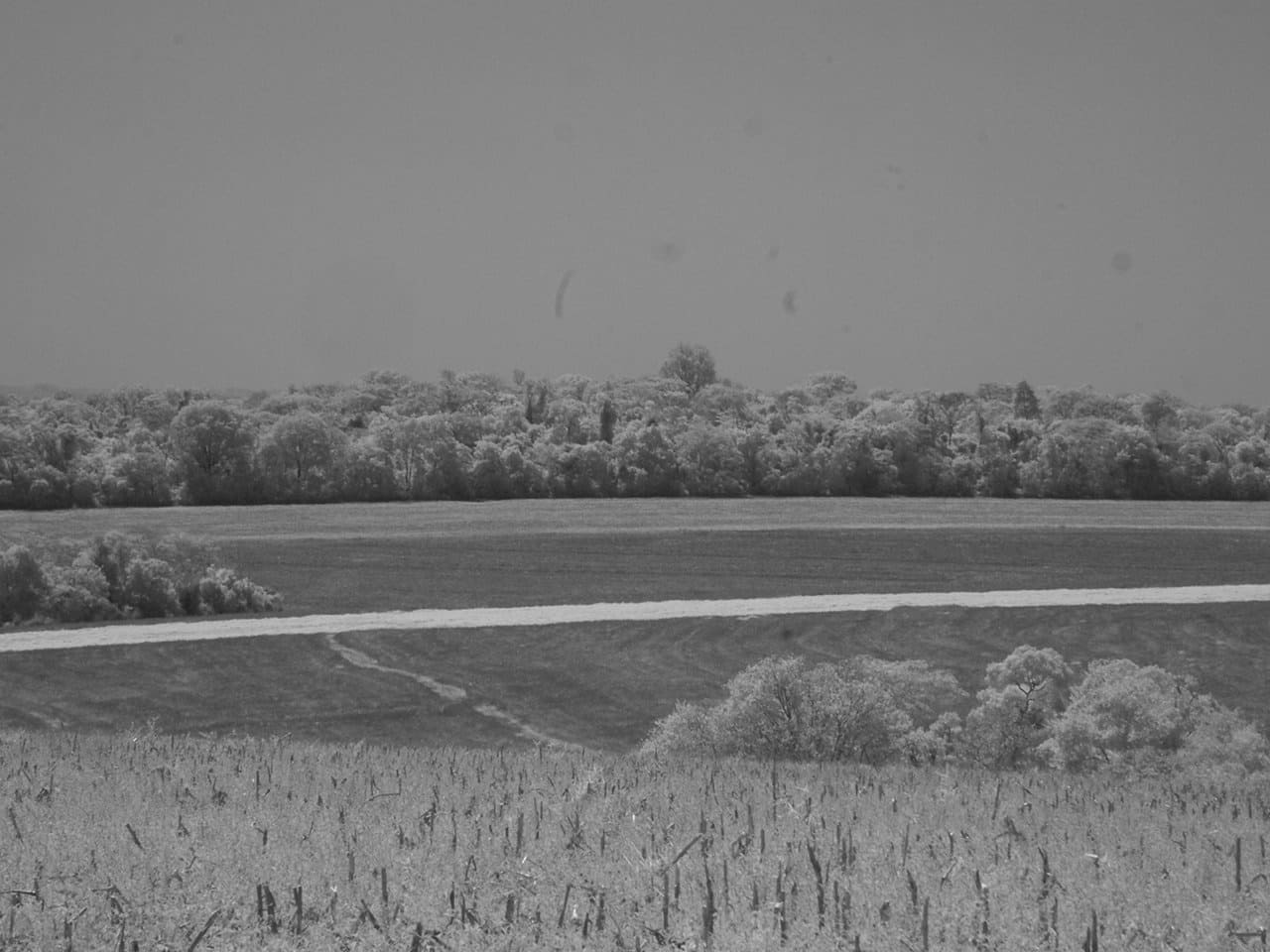
Almost 10 years later, San Juan is still surrounded by soybeans. Arriving in the community means greeting more than one fumigation truck in the 15 minutes it takes to travel from the town to Katueté, the nearest city.
In a roundtable organized by the National Peasant Federation, half of the 20 attendees are relatives of the children in whom Stela Benitez’s team found comets in their DNA.
The meeting in Colonia San Juan is a typical gathering. It is led by a woman, Sonia Acevedo, whose backyard is frequented by single mothers, men weathered by the sun, and schoolchildren leaving class. Sonia, like so many other Paraguayan women, acts as a bridge between our hurried city accent and rural life. No Spanish, only Jopará. Through her, one of the attendees, Paola, shows us how small planes carrying out aerial fumigation can still be seen from her patio.
Paola does not want to give her last name. The community lives in a tenuous peace with the plantation owners who are advancing in a slow-motion apocalypse on the village.
“Cell damage can be repaired and that’s it,” explains Dr. Benítez. “Or it can lead to cancer, diabetes, growth problems, and miscarriages.” Traces of agrochemicals do not end with the people exposed to them, but “genetic damage can be inherited by their children. We are talking about generations at risk.”
Sonia Acevedo says that it is mainly girls who show evidence of genetic damage. The reason, according to her, is that girls have longer hair, and therefore “the poison sticks to their heads more.” She jokes about the possibility of proposing to the federation “that we all start having short hair.”
The group laughs. The girl behind one of the women present brushes her hair back, concerned.
The farmers of San Juan never received a visit from the Ministry of Health after the results of Stela’s scientific research were published. Nor does the National Peasant Federation (FNC) have a say in the National Climate Change Commission, the body that votes on the country’s policies in this area.
This is despite the fact that the FNC is not only the largest organization of small producers in the country, but also the oldest. The situation is different for the agro-export sector, which is represented by five associations in the same Commission.
Marcial Gómez, secretary general of the Federation, echoes what Sonia in San Juan and Norma in Yerutí said: “It is becoming increasingly difficult to plant anything. Drought and pests are killing all the crops.” In San Juan, even cassava, the most important crop in Paraguayan cuisine, capable of overcoming the worst conditions, suffers from a lack of nutrients in the soil and an excess of agrochemicals around it. “We are invaded by whiteflies fleeing from the soybean fields.” Acevedo also points out that, due to the fact that they are surrounded by soybeans, the farmers of San Juan cannot certify their own crops as organic, which could be an alternative for higher incomes. “If someone comes and analyzes what we plant, they will see the glyphosate.”
Lis García, a researcher specializing in agribusiness in Paraguay and part of the think tank BASE IS, explains that “part of this new narrative where soy is sold as part of regenerative agriculture is because, in reality, genetically modified crops tend to fail, because their profitability depends on the extent of cultivation.” It is a dangerous cocktail, she says, “because it leads to greater concentration of land and economic resources in the hands of a very small group of the population. An accumulation through dispossession.”
The researcher also points out the historical injustice that led to Paraguayan soybean expansion. «Paraguayan peasants were the arms that opened the agricultural frontier to the east during the dictatorship. An expansion that was later enjoyed by Brazilian producers.“ This feature defined much of the deforestation driven by Alfredo Stroessner’s dictatorship in the Atlantic Forest during the second half of the 20th century, a production model that not only contributes to climate change in terms of emissions, but is also ”a race for control of life.»
Sonia Acevedo watches from her patio as people disperse at the end of their second hour of work in the fields. From her house, an endless field of soybeans challenges the eyes’ ability to imagine a horizon.
“Regenerative agriculture… they don’t know what else to make up,” she says.
In Belém, it seems that the Paraguayan government and Big Ag is willing to defy its astonishment.
.